Empowering pre-service EFL teachers and learners towards democratic futures
Project members: Rachelle Breuer, Anni Lenz, Bianca Roters (University of Education Ludwigsburg, Germany) & Julia Fuchs (Doris-Leibinger-Grundschule Ditzingen)
This project connects Inclusive Linguistics with narrative learning, well-being and learner agency. Narrating Futures of Well-Being in EFL Teacher Education explores how storytelling can create meaningful spaces for language learning, well-being, participation, and agency. Placing oral, written, digital, and multimodal narratives at the centre of EFL learning, the project investigates how stories enable young learners to engage with experiences of challenge, belonging, hope, and change while developing their linguistic resources and their own voices. Grounded in principles of social equity and inclusive education, the project adopts a relational understanding of resilience. Rather than viewing resilience primarily as an individual capacity to cope with adversity, it considers the role of supportive relationships, access to resources, belonging, and opportunities for meaningful participation. Drawing on Rebecca Oxford’s EMPATHICS framework (2016), particular attention is given to the interplay of empathy, meaning, motivation, well-being and learner agency. Storytelling is understood as more than a vehicle for language input. Picturebooks, digital stories, graphic narratives and other multimodal texts can open spaces for perspective-taking, meaning-making and narrative agency.
A central focus of the project lies on story-based tasks. These are understood as meaning-oriented and outcome-focused invitations to engage with, respond to and transform narratives. Learners may explore perspectives, negotiate meanings, connect stories with their own experiences or create alternative voices, scenes and possible futures. Inclusive literacy practices, including phonological awareness where appropriate, can support learners in accessing texts and contributing to shared meaning-making. Such support remains embedded in meaningful narrative activity rather than being treated as an isolated technical skill.
Within EFL teacher education, the project investigates how pre-service teachers select narratives and design, scaffold and reflect on story-based tasks for heterogeneous classrooms. A particular interest lies in balancing structure with openness: providing sufficient linguistic, literacy-related and multimodal support for learners to participate while preserving space for individual meanings, perspectives and forms of expression.
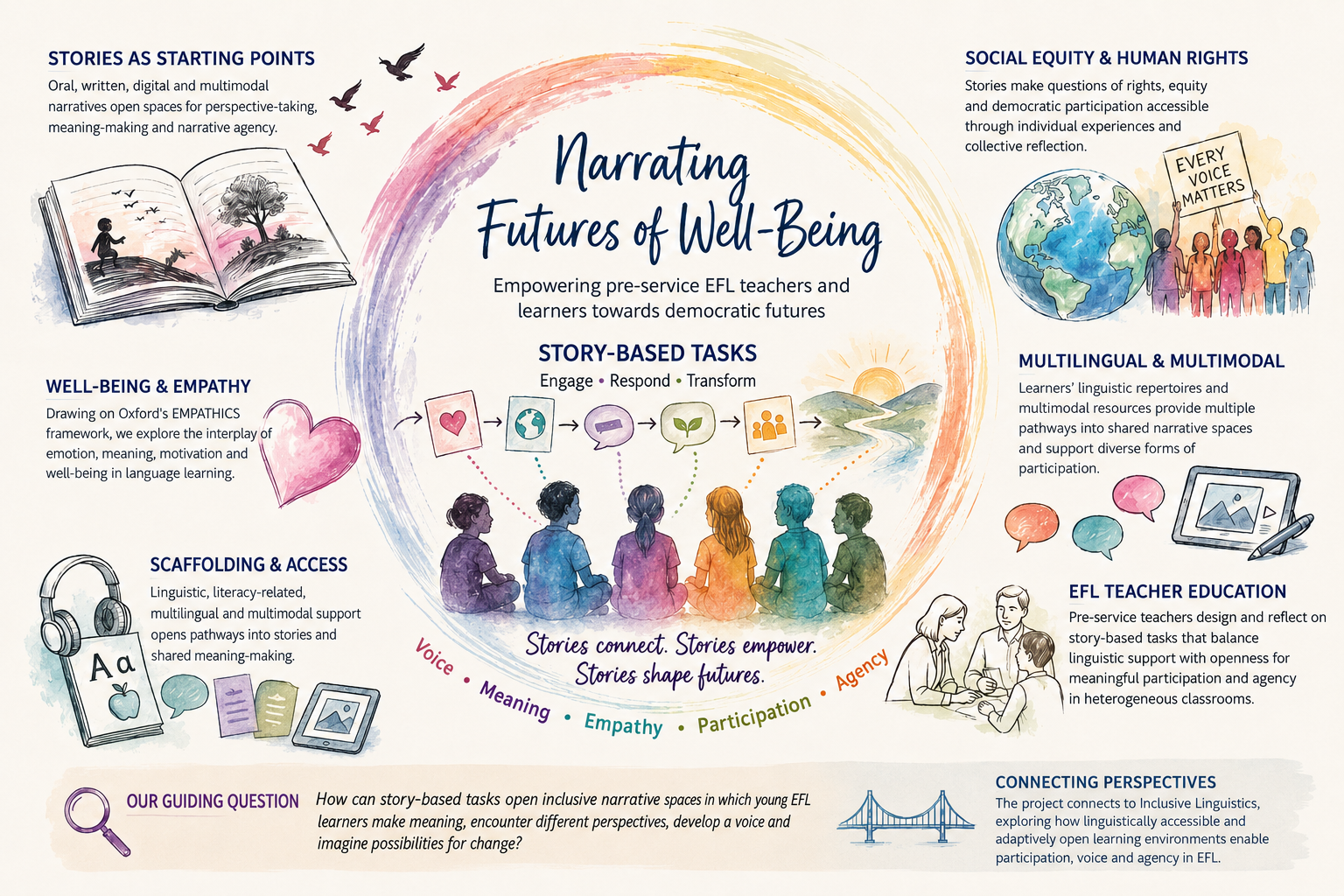
Our guiding question:
How can story-based tasks open inclusive narrative spaces in which young EFL learners make meaning, encounter different perspectives, develop their voice and imagine possibilities for change?
Keywords: Story-Based Tasks · Storytelling · Well-Being · Inclusive Literacy · Narrative Agency · Multilingualism · Human Rights Education · EFL Teacher Education
Project Activities & Outputs
Webinar Using Storytelling to Strengthen Well-Being in EFL Education. Sharing Languages. (September 2026), together with Rachelle Breuer, Julia Fuchs & Anni Lenz
Conference Presentations:
Lenz, Anni & Roters, Bianca: Storytelling and the Language of Well-Being: Mindful Plurilingual Pedagogies in EFL Teacher Education for Re-imagining Human Rights Education in a Turbulent World. Poster Presentation IAHRE Conference, Münster, Germany – Re-imagining Human Rights Education in a Turbulent World (May 2026)
Breuer, Rachelle & Roters, Bianca: Promoting Social Equity and Inclusion through Digitally-Mediated Reading Tasks in Pre-Service EFL Teacher Education. 21st ISATT Biennial Conference of the International Study Association on Teachers and Teaching, University of Glasgow (July 2025)
Student Research:
Lenz, Anni (2025). Promoting Meta-Linguistic and Metacognitive Abilities Using English Picture Books – a Comparative Analysis of Special Needs and Primary School EFL Contexts. Unpublished MA thesis.
Research–Teaching Connection:
Selected courses serve as development and reflection spaces in which pre-service teachers analyse narratives and design linguistically supported, meaning-oriented and open-ended story-based tasks for heterogeneous EFL classrooms.
Narrate (Your) Stories: Story-Based Tasks in Applied Linguistics (cooperative seminar BA-MA, together with Rachelle Breuer), Ludwigsburg University of Education
From Story to Agency – Teaching Young Learners through Tasks: A Cognitive Neuroscience & Linguistic Perspective, Ludwigsburg University of Education