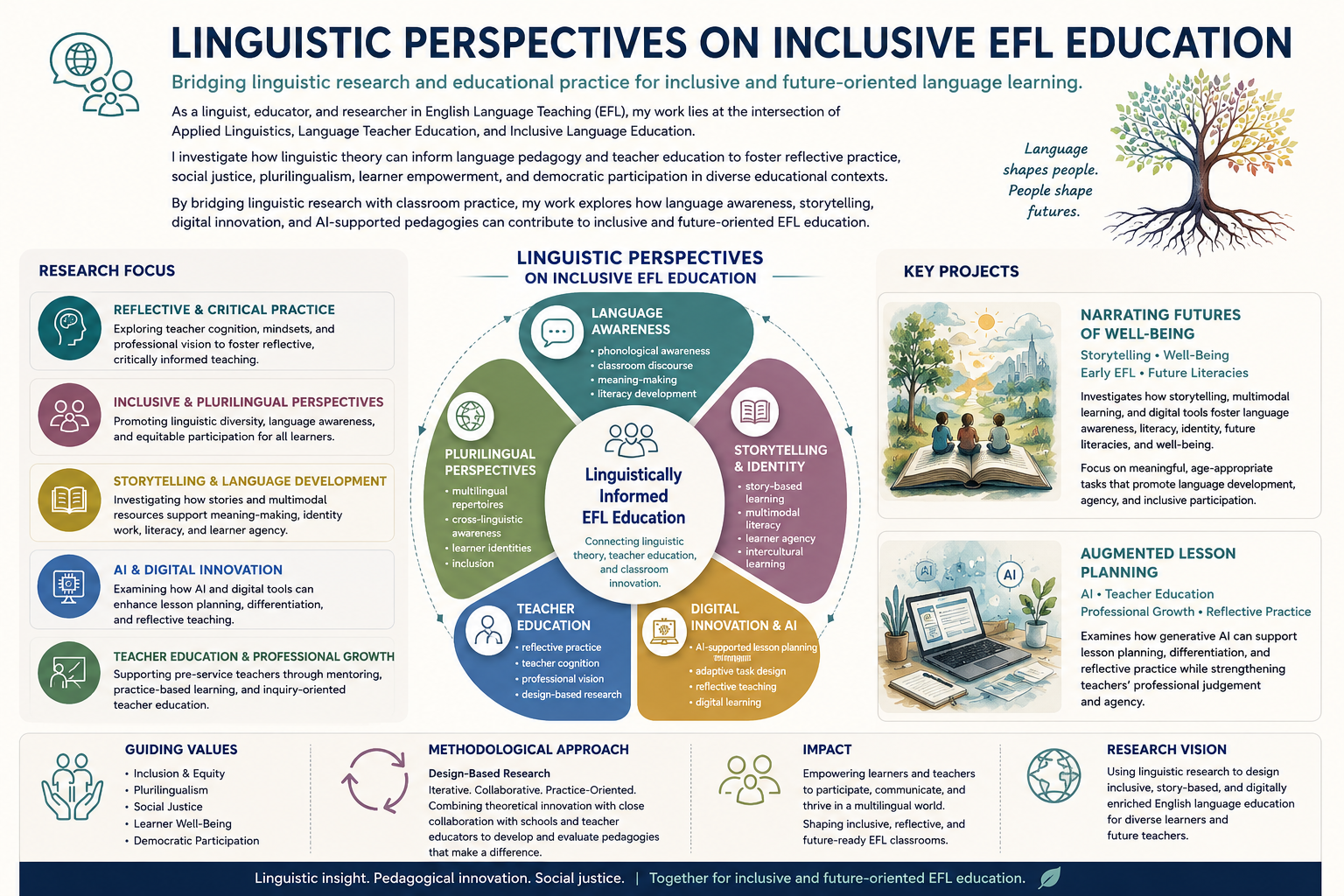
Using Applied Linguistics to shape inclusive, linguistically responsive, and future-oriented English language teacher education
As a linguist, educator, and researcher in English Language Teaching (ELT), my work lies at the intersection of Applied Linguistics, English Language Teacher Education, and Inclusive Language Education. My research explores how insights from Applied Linguistics can inform the education of future English language teachers by advancing linguistically responsive approaches to language and literacy development in multilingual and digitally enriched classrooms.
A central strand of my research focuses on Early EFL education, examining how storytelling creates rich linguistic contexts for language and literacy development, meaning-making, learner agency, and language awareness (cf. our project Narrating Futures of Well-Being). Drawing on usage-based, cognitive, and cultural perspectives on language, I investigate how stories support language awareness and inclusive language learning. Together with pre-service teachers, we design meaningful, age-appropriate learning environments that strengthen language awareness, reading engagement, and inclusive participation.
I also examine how AI can support linguistically informed pedagogical decision-making through adaptive task design and reflective lesson planning while strengthening teachers’ professional judgement and agency (cf. our project augmented lesson planning). Through case-based mentoring, school partnerships, and practice-oriented teacher education, I work with pre-service teachers to translate linguistic research into innovative classroom practice.
Across my research, I adopt a Design-Based Research approach to connect linguistic theory with educational innovation through iterative development and close collaboration with schools and teacher educators. By integrating insights from Applied Linguistics, language and literacy development, multilingualism, storytelling, and digital technologies, I aim to contribute to a linguistically informed, socially responsive, and future-oriented vision of English language teacher education.
Research Perspectives: Linguistically informed innovation in English language teacher education
Task-Based Language Learning (TBLL)
Integrating real-world tasks, AI-driven lesson planning, and digital tools to create linguistically responsive, learner-centered pedagogy (see for example our article on tasks for young learners).
Linguistics for Inclusive & Digital Education
Inclusive EFL Education: Using linguistics to shape inclusive, reflective, and tech-enhanced language teaching (e.g. our article in TESL-EJ, available online).
Dynamic Systems Theory in AI-supported learning environments: flexible, technology-enhanced learning trajectories, ensuring AI-driven tools adapt to learners’ evolving needs (see for example our project on Augmented EFL Lesson Planning).
Critical and Cultural Perspectives on Language
Exploring how language, identity, and power interact and how it shapes EFL teachers’ reflective practice (see for example our project
Plurilingual Practice and Pedagogical Reflection or the role of bridging tasks (Schildhauer & Roters 2025)
Story-Based Tasks in EFL
Leveraging narrative, multimedia, and creative expression to foster language development, critical literacy, and intercultural understanding (see for example our project Narrating Futures of Well-Being).
Applied Linguistics for Inclusive and Future-Oriented English Language Teacher Education
An emerging strand of my research draws on cognitive and cultural perspectives on language to investigate how learners construct meaning through stories, multilingual resources, and authentic communication. This perspective will further inform my work on language awareness, literacy development, and inclusive English language teacher education.