Cognitive, Affective, and Linguistic Individual Challenges
Project members: Anni Lenz (doctoral researcher), Bianca Roters (supervisor, University of Education Ludwigsburg, Germany)
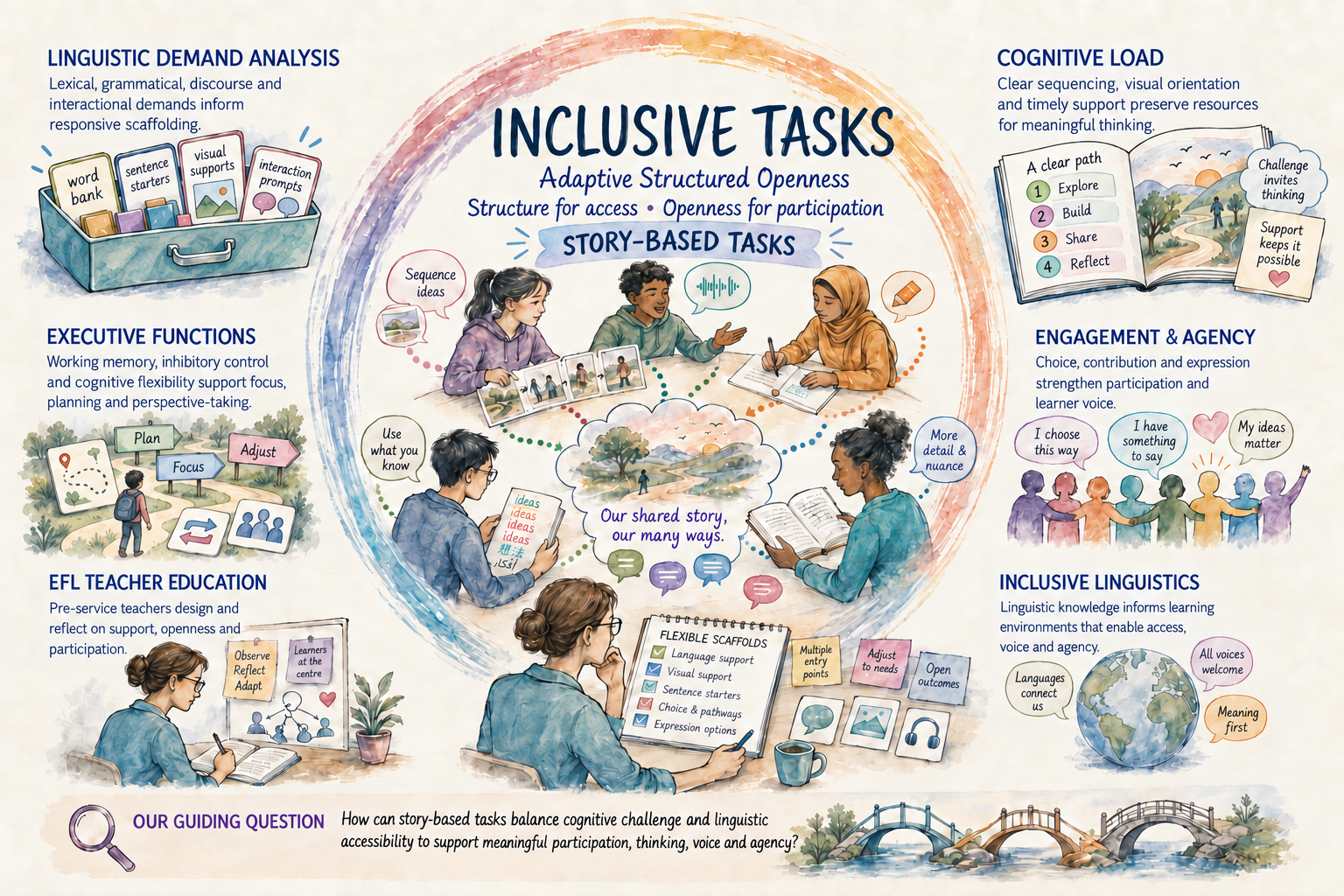
This project translates Inclusive Linguistics into principles for cognitively engaging and linguistically accessible task design. In our research project, we explore how inclusive task design can create meaningful opportunities for linguistic participation in heterogeneous EFL classrooms. It focuses on the interplay between linguistic accessibility, learner engagement and agency, asking how tasks can provide sufficient structure and support while remaining open to diverse linguistic resources, pathways and forms of expression. Drawing on Oxford’s EMPATHICS framework (2016), the project also considers how emotion, empathy, meaning, motivation and learner agency shape engagement with cognitively and linguistically demanding tasks. Stories can create meaningful contexts in which young learners use language to explore ideas, question information, solve problems and make decisions. Story-based tasks therefore connect linguistic participation with the development of thinking skills. Their inclusiveness, however, depends on more than the intellectual quality of the questions they pose. Learners must also be able to understand the task, manage its demands and express their emerging ideas. The project examines this relationship through three interconnected perspectives:
Executive Functions
Executive functions—including working memory, inhibitory control, cognitive flexibility, planning and monitoring—help learners remain focused, hold information in mind, shift between perspectives and organise a response. Story-based tasks can activate these processes when learners sequence events, infer motives, compare possible actions or reconsider an interpretation. Task design should support these processes without determining the learners’ conclusions.
Cognitive Load
A cognitively stimulating task is not necessarily an accessible task. Learners may need to coordinate story content, visual information, instructions, unfamiliar language and interaction at the same time. Inclusive task design therefore seeks to manage avoidable cognitive load through clear task sequences, visual orientation, modelling and carefully timed scaffolding. The aim is not to remove intellectual challenge, but to preserve learners’ cognitive resources for meaningful thinking, interaction and decision-making.
Linguistic Demand Analysis
Linguistic demand analysis identifies the language learners need to access a story, understand the task and participate in its communicative outcome. It considers receptive and productive demands at lexical, grammatical, discourse and interactional levels. On this basis, teachers can provide responsive support such as visual resources, sentence openings, key expressions, multimodal response options and opportunities to draw on plurilingual repertoires.
Together, these perspectives extend the principle of adaptive structured openness. Structure reduces unnecessary barriers and makes participation possible; openness preserves different interpretations, linguistic pathways and forms of expression. Adaptation responds to the interaction between the learner, the story, the task and the emerging classroom situation. Particular attention is given to story-based and meaning-oriented tasks that enable learners to contribute at different levels of linguistic complexity while participating in a shared communicative space. The project contributes to an emerging framework of Inclusive Linguistics, which examines how linguistic knowledge can inform the design and analysis of learning environments that enable access, meaningful contribution, interaction, voice and agency in EFL education.
Guiding Question:
How can story-based tasks balance cognitive challenge and linguistic accessibility in ways that support meaningful participation, thinking, voice and agency in heterogeneous EFL classrooms?
Project Activities & Outputs
Conference Presentations & Workshops:
Lenz, A. & Roters, B. Re-imagining Human Rights Education through Storytelling: Malala’s Magic Pencil in Early EFL Teacher Education. TEFL 10 Conference, Nova University Lissabon (November 2026)
„Unterricht weiterdenken: Individuelle Lernwege im digitalen Zeitalter“ (23.9.2026), Pädagogisches Landesinstitut Rheinland-Pfalz, Workshop (online)
One child, one teacher, one book and one pen can change the world…Story-based tasks in the EFL Classroom from a plurilingual perspective (invited online guest lecture, October 2026, Kryvyi Rih State Pedagogical University, Ukraine)
Doctoral Research Project:
Anni Lenz: Towards Inclusive Future Literacies: From Collecting Words to Imagining Futures – A Design-Based Study in the Early EFL Classroom
Publications:
Lenz, A. & Roters, B. (in preparation) Perspectives on Story-Based Tasks as Metacognitive Practice in EFL Education. Textes et Contextes (22-1, June 2027)
Research–Teaching Connection:
Selected courses provide development and reflection spaces in which pre-service teachers analyse, design and evaluate inclusive EFL tasks. Particular attention is given to the relationship between linguistic accessibility, meaningful communication, learner choice and flexible forms of participation.
Linguistic Accessibility in the EFL Classroom, Ludwigsburg University of Education
Narrating (Your) Futures: Stories We’re Told and Stories We Tell, Ludwigsburg University of Education